


Scientific laboratories at The Pirbright Institute have achieved bronze status under the Laboratory Efficiency Assessment Framework (LEAF) after improving sustainability and reducing environmental impact.
The Institute’s containment level 3 (CL3) facilities support UK research on high-consequence viruses. CL3 is a high-security laboratory setting for studying dangerous and often airborne pathogens. The core facility includes two laboratory suites that have achieved bronze LEAF status.
Pirbright signed up to LEAF last year. Staff recognised that the University College London (UCL)-developed LEAF programme could help Pirbright improve the sustainability, efficiency and safety of the CL3 laboratories. The framework helps labs reduce waste, plastic use, water consumption and energy, while also tracking carbon and financial savings. Laboratories can achieve bronze, silver or gold accreditation based on criteria related to equipment, management and research quality.
The programme recognises laboratories taking practical steps across areas such as waste management, up-to-date training records, energy and materials considerations during purchasing, and clear labelling of samples and chemicals.
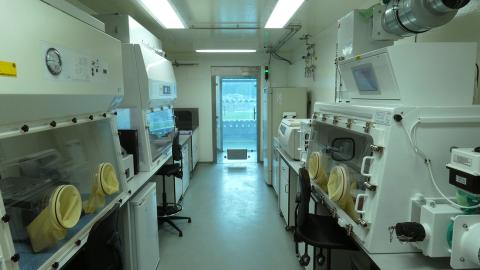
Dr Christopher Sanders, Entomology Group Leader, said bronze accreditation marked an important first step for the Institute.
“We were able to identify where existing controls already met LEAF objectives and what adjustments were needed to reach bronze level. Many of the changes - such as energy-use reminders on equipment - were simple to incorporate and applicable to many labs onsite.”
Loni Mayhew, CL3 Laboratory Manager, said:
“LEAF has empowered us to challenge the assumption that high-containment laboratories cannot support sustainability. We have focused on small but achievable improvements. For instance, adjusting freezer temperatures to -70°C where possible - a simple step that can save up to 30% in energy use.”
Plastic that does not enter the lab can be recycled, and items that survive autoclaving can be reused. Pipettes are calibrated and irreparable ones traded in, and sustainability is now included as a standing agenda item in user meetings.
The work towards bronze accreditation has also helped establish Institute-wide guidance, making it easier for other laboratories to follow. More information about Pirbright’s CL3 laboratories can be found here.